Vulnerability mapping
Map a CVE description to a canonical weakness or a CVSS severity vector.
CVE descriptionCWE / CVSS
Accepted at TMLR · 2026
The idea
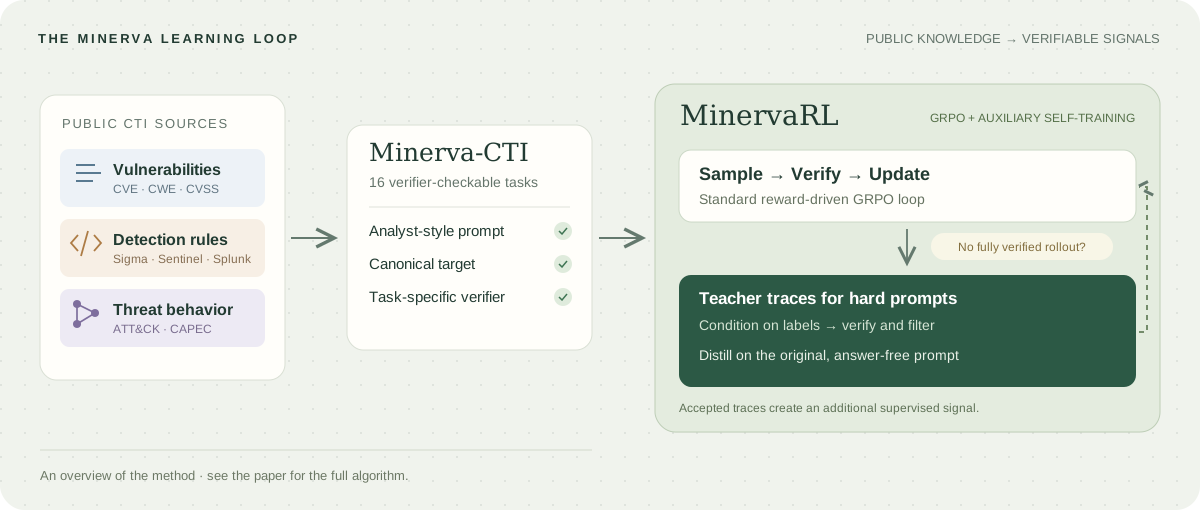
CTI analysts turn messy security information into structured outputs: weakness identifiers, attack techniques, severity vectors, and more. These outputs can often be checked against public standards, making CTI a natural setting for reinforcement learning with verifiable rewards.
Minerva pairs a curated training suite with MinervaRL, a method that supplements GRPO with verified teacher traces when a model struggles to produce a fully correct answer.
Cyber threat intelligence (CTI) analysts routinely convert noisy, unstructured security artifacts into standardized, automation-ready representations. Although large language models (LLMs) show promise for this task, existing approaches remain brittle when producing structured CTI outputs and have largely relied on supervised fine-tuning (SFT). In contrast, CTI standards and community-maintained resources define canonical identifiers and schemas that enable deterministic verification of model outputs. We leverage this structure to study reinforcement learning with verifiable rewards (RLVR) for CTI tasks. We introduce Minerva, a unified dataset and training pipeline spanning multiple CTI subtasks, each paired with task-specific verifiers that score structured outputs and identifier predictions. To address reward sparsity during rollout, we propose MinervaRL, an auxiliary self-training mechanism that generates additional verified trajectories and distills them back into the model. Averaged across four backbones and 12 CTI benchmarks, MinervaRL improves the mean score by 15.8 percentage points over the corresponding base models and by 4.3 points over GRPO.
Score improvements are averaged across four backbones and 12 evaluation benchmarks. pp = percentage points.
01 / Minerva-CTI
Minerva-CTI turns public standards, knowledge bases, and detection resources into 16 training tasks. Each example pairs an analyst-style prompt with a canonical target and a task-specific verifier. The split contains 32,000 training and 1,200 validation instances.
Map a CVE description to a canonical weakness or a CVSS severity vector.
Connect detection rules and emulation tests to ATT&CK techniques.
Identify techniques, tactics, and mitigations from attack scenarios.
Link actor behavior and CAPEC examples to structured security knowledge.
Representative task groups. Sources include MITRE ATT&CK/CWE/CAPEC, CVE/NVD, Mappings Explorer, Sigma, Atomic Red Team, Microsoft Sentinel, and Splunk Security Content.
02 / MinervaRL
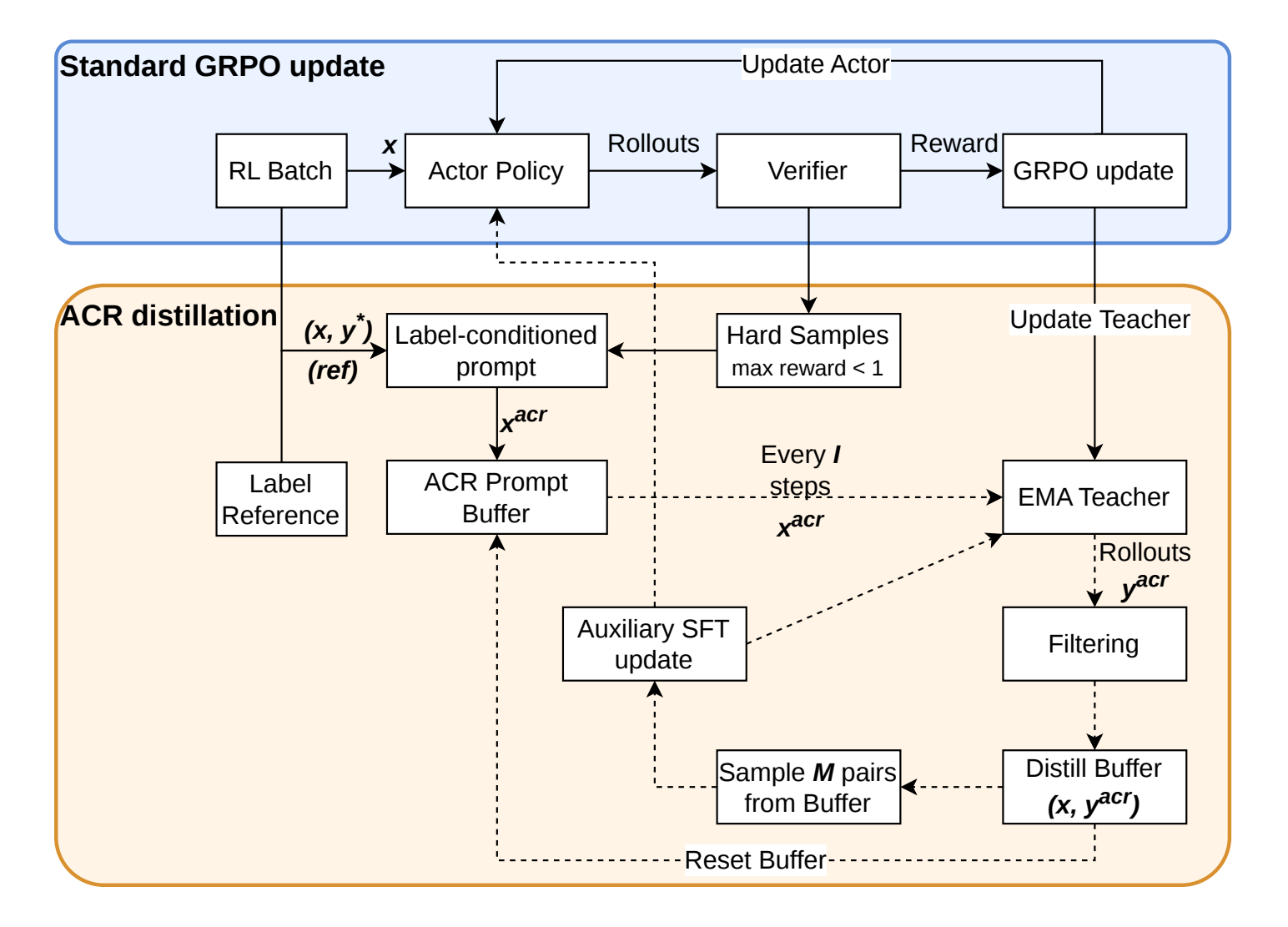
MinervaRL keeps the standard GRPO loop and adds an auxiliary self-training path. Prompts without a fully verified rollout receive extra help from a teacher. Accepted traces are distilled back onto the original, answer-free prompts.
Generate eight on-policy rollouts per prompt and score them with the task verifier. Continue the standard GRPO update.
If no rollout is fully verified, an EMA teacher generates traces conditioned on the target labels. Verify them and filter for quality.
Periodically distill accepted traces onto the original prompt, without the target labels. This adds a supervised learning signal.
The distinction matters. Labels help generate the teacher trace; the student learns from the original, answer-free prompt. The auxiliary update supplements the GRPO objective.
03 / Main results
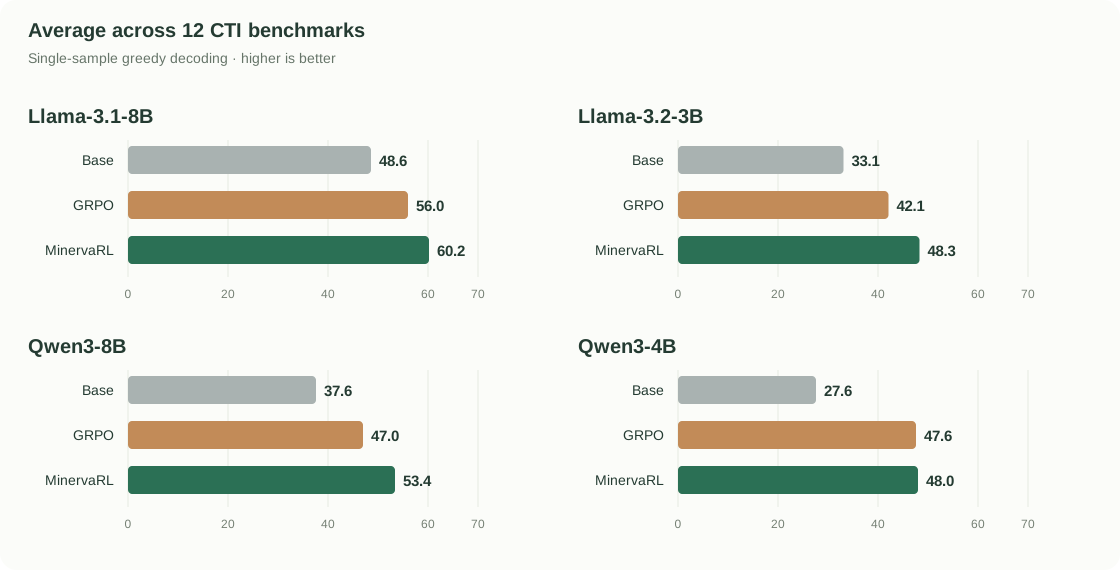
Across 12 CTI benchmarks and four open-weight backbones, MinervaRL improves the mean score by 15.8 percentage points over the corresponding base models and by 4.3 points over GRPO. It has the highest average within each backbone group in the reported comparisons.
| Backbone | Base | STaR-CTI | DART-CTI | GRPO | LUFFY-CTI | MinervaRL |
|---|---|---|---|---|---|---|
| Llama-3.1-8B | 48.6 | 49.7 | 53.7 | 56.0 | 57.0 | 60.2 |
| Llama-3.2-3B | 33.1 | 37.3 | 44.0 | 42.1 | 45.4 | 48.3 |
| Qwen3-8B | 37.6 | 36.8 | 42.9 | 47.0 | 53.2 | 53.4 |
| Qwen3-4B | 27.6 | 45.4 | 39.4 | 47.6 | 44.0 | 48.0 |
Paper Table 1. Scores are percentages; the macro average combines the 12 task metrics. Llama backbones start from Instruct checkpoints; Qwen3 backbones start from Base checkpoints. STaR, DART, and LUFFY are the CTI adaptations used in the paper.
| Backbone / method | CKT | CyberMetric | SOCEval | RCM | VSP | ATE | RMS | ElasticRule | APTNER | LANCE | AnnoCTR | AZERG | Avg. |
|---|---|---|---|---|---|---|---|---|---|---|---|---|---|
| Llama-3.1-8B / Base | 67.6 | 83.2 | 64.8 | 48.4 | 76.0 | 17.4 | 6.7 | 14.4 | 33.5 | 78.2 | 50.7 | 42.8 | 48.6 |
| Llama-3.1-8B / STaR-CTI | 70.0 | 81.8 | 61.7 | 57.4 | 73.8 | 29.2 | 9.6 | 21.3 | 33.1 | 80.0 | 46.5 | 32.1 | 49.7 |
| Llama-3.1-8B / DART-CTI | 71.3 | 82.4 | 61.5 | 64.0 | 73.0 | 37.8 | 27.7 | 31.0 | 34.0 | 74.8 | 47.1 | 39.3 | 53.7 |
| Llama-3.1-8B / GRPO | 71.9 | 85.4 | 63.0 | 66.3 | 82.6 | 32.0 | 30.9 | 32.2 | 32.7 | 86.2 | 49.5 | 39.5 | 56.0 |
| Llama-3.1-8B / LUFFY-CTI | 73.9 | 83.7 | 63.3 | 63.8 | 79.6 | 40.6 | 34.3 | 33.8 | 35.4 | 82.4 | 49.7 | 43.1 | 57.0 |
| Llama-3.1-8B / MinervaRL | 73.9 | 84.2 | 64.7 | 68.8 | 87.6 | 48.4 | 42.1 | 40.5 | 34.1 | 84.6 | 50.3 | 43.7 | 60.2 |
| Llama-3.2-3B / Base | 71.6 | 77.0 | 55.7 | 15.2 | 2.8 | 1.0 | 0.4 | 1.2 | 25.4 | 77.8 | 35.9 | 32.8 | 33.1 |
| Llama-3.2-3B / STaR-CTI | 64.3 | 70.5 | 50.3 | 36.4 | 53.4 | 4.2 | 7.0 | 1.9 | 21.4 | 76.3 | 33.8 | 28.0 | 37.3 |
| Llama-3.2-3B / DART-CTI | 73.0 | 78.2 | 54.5 | 54.9 | 61.2 | 16.8 | 17.8 | 11.6 | 22.5 | 73.8 | 38.7 | 25.7 | 44.0 |
| Llama-3.2-3B / GRPO | 71.2 | 77.8 | 58.3 | 48.9 | 56.5 | 5.2 | 15.4 | 5.3 | 27.5 | 70.6 | 38.5 | 29.7 | 42.1 |
| Llama-3.2-3B / LUFFY-CTI | 70.6 | 78.5 | 55.4 | 43.8 | 71.6 | 19.4 | 24.2 | 20.4 | 15.0 | 68.0 | 46.0 | 32.1 | 45.4 |
| Llama-3.2-3B / MinervaRL | 71.0 | 78.1 | 54.6 | 57.2 | 77.1 | 21.8 | 29.3 | 20.1 | 16.7 | 82.2 | 37.9 | 33.7 | 48.3 |
| Qwen3-8B / Base | 71.7 | 69.3 | 63.8 | 52.6 | 69.0 | 13.4 | 6.5 | 9.0 | 31.3 | 45.1 | 9.8 | 9.8 | 37.6 |
| Qwen3-8B / STaR-CTI | 37.9 | 49.3 | 65.1 | 36.8 | 68.7 | 15.6 | 3.5 | 4.9 | 37.9 | 55.7 | 40.0 | 26.4 | 36.8 |
| Qwen3-8B / DART-CTI | 39.2 | 55.7 | 65.2 | 47.1 | 72.7 | 14.0 | 6.5 | 16.4 | 37.9 | 76.4 | 46.5 | 36.6 | 42.9 |
| Qwen3-8B / GRPO | 69.8 | 72.7 | 69.0 | 60.5 | 68.8 | 23.6 | 8.2 | 18.1 | 37.7 | 66.1 | 37.8 | 31.1 | 47.0 |
| Qwen3-8B / LUFFY-CTI | 78.6 | 88.3 | 64.8 | 65.3 | 73.2 | 29.4 | 25.8 | 32.4 | 34.3 | 74.5 | 45.1 | 26.8 | 53.2 |
| Qwen3-8B / MinervaRL | 77.8 | 88.2 | 67.5 | 64.8 | 79.4 | 32.0 | 20.1 | 22.0 | 37.4 | 74.9 | 43.0 | 33.1 | 53.4 |
| Qwen3-4B / Base | 45.6 | 50.1 | 56.1 | 45.6 | 76.5 | 4.2 | 6.5 | 4.6 | 1.2 | 18.0 | 16.6 | 6.5 | 27.6 |
| Qwen3-4B / STaR-CTI | 76.1 | 88.2 | 66.1 | 21.1 | 80.2 | 5.8 | 6.6 | 12.3 | 31.8 | 62.0 | 46.9 | 47.7 | 45.4 |
| Qwen3-4B / DART-CTI | 45.4 | 42.1 | 60.0 | 54.6 | 73.8 | 20.6 | 5.8 | 17.1 | 27.6 | 47.5 | 43.2 | 35.1 | 39.4 |
| Qwen3-4B / GRPO | 74.2 | 85.8 | 63.9 | 60.8 | 88.1 | 20.2 | 3.8 | 20.4 | 32.4 | 58.2 | 39.6 | 24.0 | 47.6 |
| Qwen3-4B / LUFFY-CTI | 54.1 | 56.5 | 60.9 | 59.9 | 72.6 | 17.6 | 10.3 | 23.4 | 29.2 | 60.4 | 46.7 | 36.2 | 44.0 |
| Qwen3-4B / MinervaRL | 70.0 | 80.0 | 64.0 | 59.9 | 80.0 | 25.4 | 5.1 | 27.5 | 28.0 | 56.7 | 50.4 | 29.1 | 48.0 |
The paper additionally reports Llama-Primus-Merged and Foundation-Sec-8B-Instruct as external security-SFT references. Consult Table 1 for those two rows.
Download the reported data (JSON) ↓Beyond the average
Task-level gains vary. Qwen3-4B has the smallest mean gain, and some tasks regress. Paired 95% bootstrap intervals give a more careful view:
Intervals reflect variation over evaluation examples for fixed checkpoints, rather than variation across training seeds.
04 / Training dynamics
The training curves connect the method to its motivation. MinervaRL reduces the fraction of prompts whose sampled rollout group earns no verifier reward and reaches the best GRPO validation accuracy earlier in training.
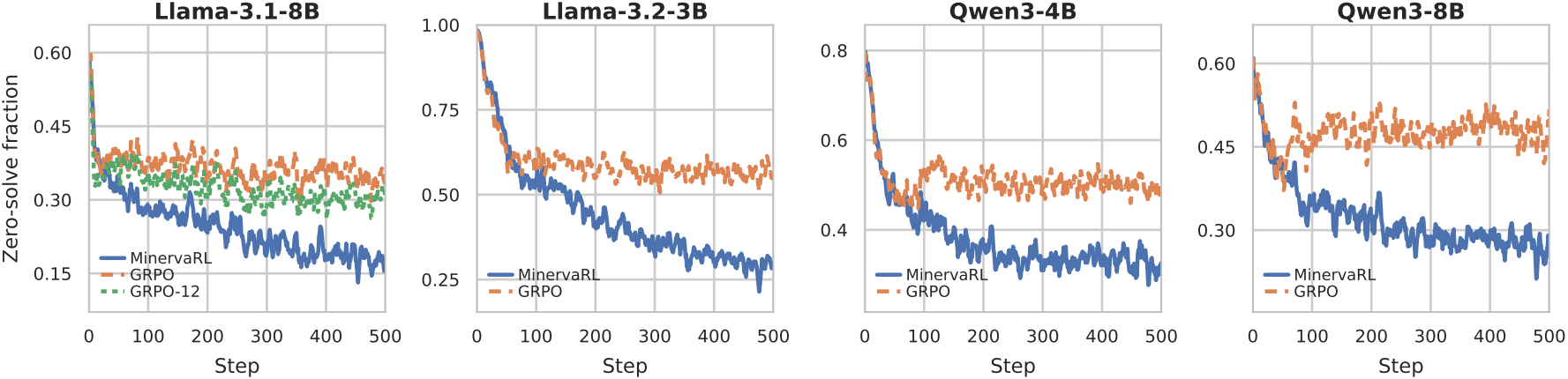
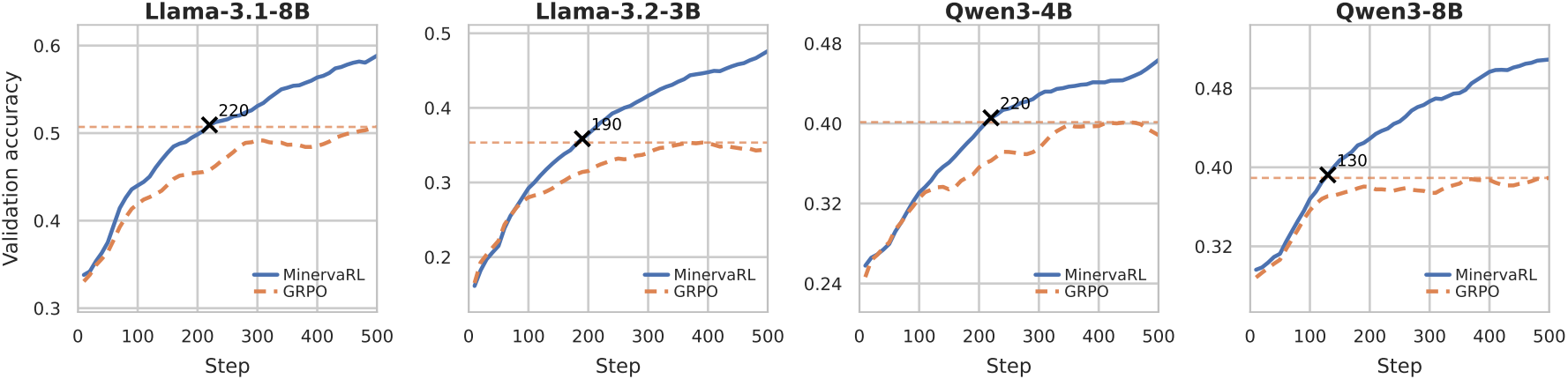
Progress has a compute cost. In the paper’s 10-step Llama-3.1-8B timing study, MinervaRL took 654.5 seconds versus 469.8 for GRPO, a 39.3% increase. Earlier progress in training steps is not a claim of lower cost per step.
05 / Scope & limitations
The strongest gains concentrate on structured, verifier-aligned tasks. Results do not imply uniform improvement on every task or establish reliability for autonomous security decisions.
Verifiable CTI tasks provide useful reward signals, and auxiliary self-training improves aggregate performance across the evaluated backbone groups.
Independent training-seed variation, broader gate and hyperparameter ablations, multilingual CTI, and reducing the cost of trace generation and filtering.
Minerva is intended for defensive CTI analysis. Its outputs support analyst judgment and require validation before operational use.
Build on this work
Accepted in Transactions on Machine Learning Research, 2026.
@article{alam2026minerva,
  title = {Minerva: Reinforcement Learning with Verifiable Rewards for Cyber Threat Intelligence LLMs},
  author = {Alam, Md Tanvirul and Piplai, Aritran and Cardei, Ionut and Rastogi, Nidhi and Worth, Jr., Peter J},
  journal = {Transactions on Machine Learning Research},
  year = {2026},
  url = {https://openreview.net/forum?id=w1IMu9exKC}
}